Grinding, Shot Blasting or Scarifying: Which Concrete Preparation Method Does Your Floor Need?
Buying guide · 7 min read · 5 October 2026
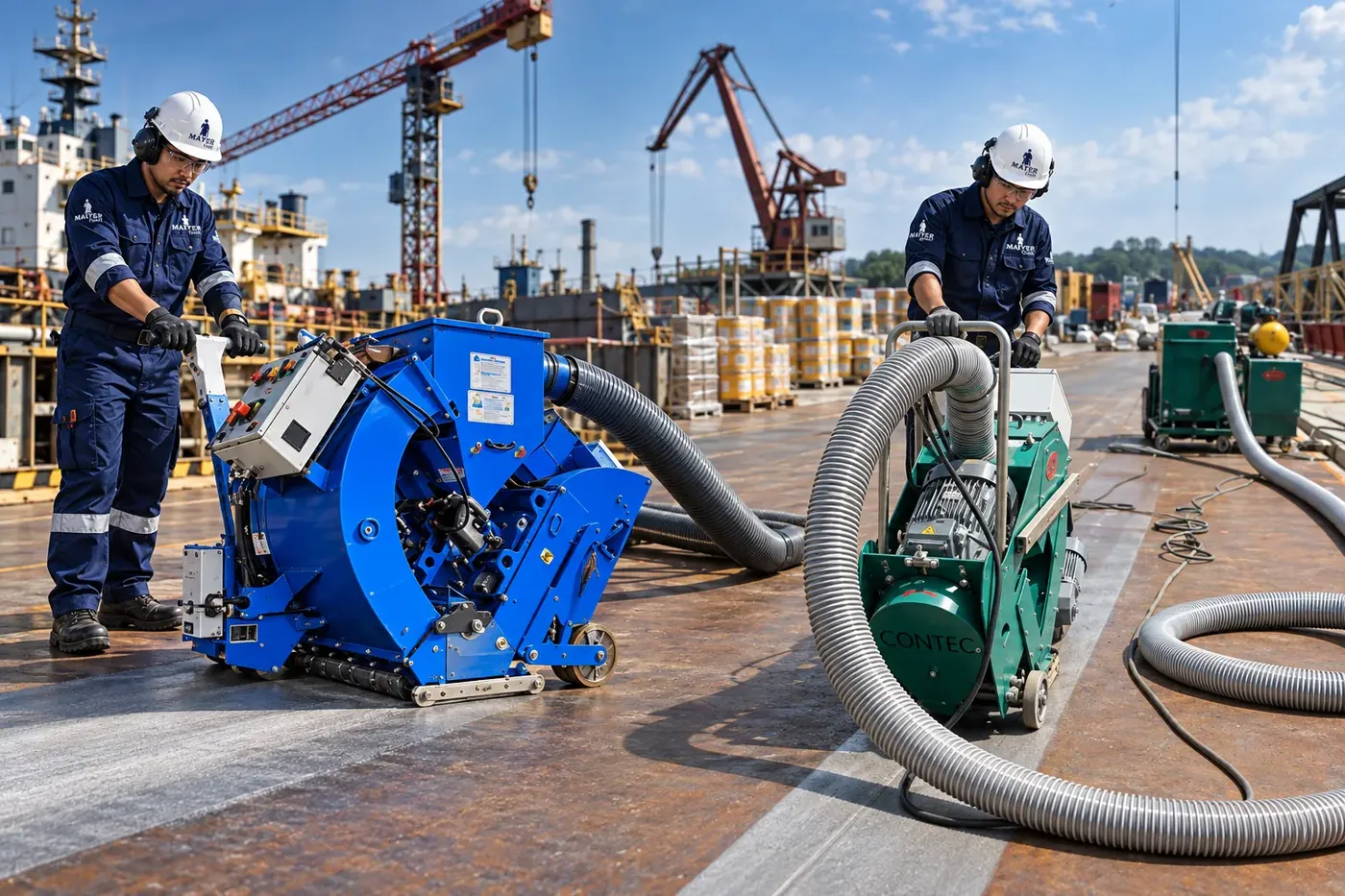
Grind for polished concrete and smooth finishes, shot blast to clean and roughen a slab for coatings, and scarify to remove thick layers. How rough the floor must be decides.
Grind when the floor is going to be polished, or when the coating needs only a fine, smooth key. Shot blast when a large slab needs cleaning and roughening before a coating or overlay. Scarify when there is a thick layer to remove, such as an old overlay or heavy coating, or when the floor needs levelling. In every case the deciding question is the same: how rough does the next layer need the concrete to be?
Start with the surface profile, not the machine
Coatings, overlays and repair mortars need the concrete to have a certain texture so they can grip. That texture is called the surface profile. The International Concrete Repair Institute (ICRI), the industry body that sets the reference for this, grades it on ten Concrete Surface Profiles, or CSP for short. CSP 1 is almost smooth. CSP 10 is very rough, with peaks and hollows more than 6 mm deep.
ICRI also publishes a set of ten reference chips moulded to each profile. On site, you hold the chips against the prepared floor and note the number that matches most closely. That turns "rough enough" from an opinion into something you can check.
Two points matter before you pick a machine:
- The product you are laying decides the profile. Coating and overlay manufacturers often state the profile their product needs on the data sheet. In ICRI's own worked example, a high-build coating calls for CSP 3 to 5.
- Write a range into the specification, then check it. ICRI recommends specifying a CSP range for the job, so the finished surface can be compared against the chips before anything is applied.
ICRI's comparison chart shows the range each method typically produces:
- Grinding: CSP 1 to 2
- Shot blasting: CSP 2 to 9
- Scarifying: CSP 4 to 7
Grinding
How it works
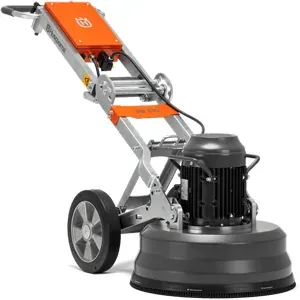
A floor grinder works the surface with diamond tooling on rotating discs, using the weight of the machine to keep the tooling cutting. Planetary grinders carry several discs on a rotating head, and the same machine can remove coatings, grind and polish concrete.
Grinding also removes coatings and adhesives. Tooling with PCD (polycrystalline diamond) segments is made for this: it tears through glue, elastic coatings and strongly bonded coatings such as epoxy, and leaves a noticeably scratched surface behind.
What it leaves
Grinding produces the finest profiles on the scale, CSP 1 to 2, and heavy grinding with PCD tooling can reach about CSP 3. That makes it the natural route for polished concrete, where the same machine carries on from preparation into polishing.
Watch out for
- It cannot make a coarse profile. If the data sheet asks for more than CSP 3, the job needs shot blasting or scarifying.
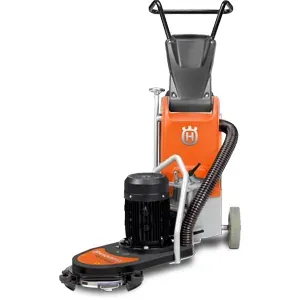
- Edges. A large grinder cannot reach right up to walls or under low fittings. Edge grinders take the same tooling as the main machine, so each grinding step can be matched along the edges.
See the range of floor grinders and polishers.
Shot blasting
How it works
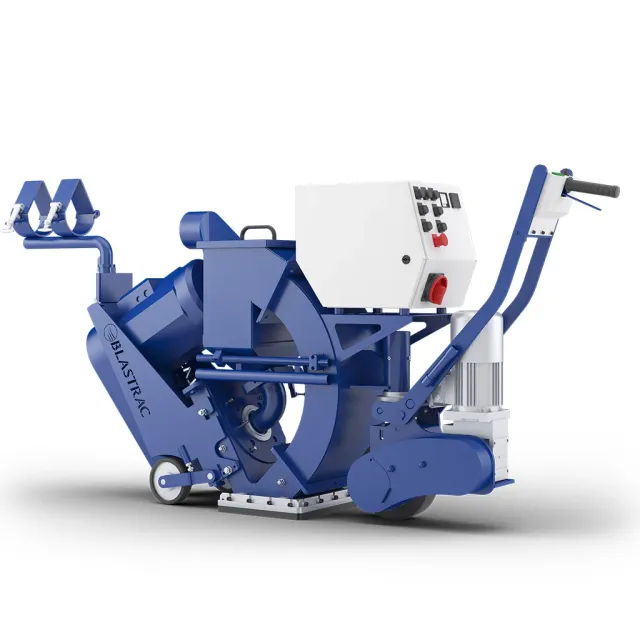
A shot blaster throws small steel abrasive down onto the floor. The impact removes surface contamination, paint, sealers and thin coatings. The machine then separates the abrasive from the debris and reuses it, in a closed circuit, while a dust collector connected to the machine takes away the dust. No water or chemicals are involved.
The grade of abrasive changes the result. A standard grade gives a medium profile, removes the weak surface layer (laitance) from new concrete and takes off coatings about 1 to 3 mm thick. A coarser grade is used for a rougher profile and for removing flexible coatings, such as those on car park decks.
What it leaves
Shot blasting covers the widest range of the three: CSP 2 to 9 on ICRI's chart. Within that, the profile depends on the size of the steel shot, how fast the machine travels and how much shot it throws. For coatings that need CSP 3 to 5 in a dust-free environment, ICRI's example names a contained system such as shot blasting as an appropriate choice.
Watch out for
- The floor must be dry and level. Shot blasters are made for dry, horizontal surfaces. If the slab has been washed or rained on, wait until it has dried.
- Edges and corners. Even machines built to work close to walls leave a margin, so plan for an edge grinder.
See shot blasters and scarifiers.
Scarifying
How it works
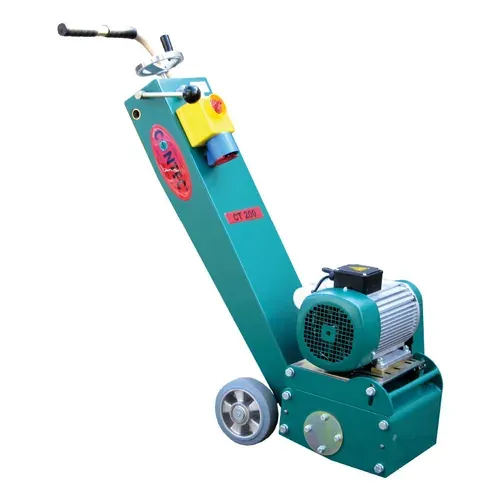
A scarifier, also called a floor planer or milling machine, uses a rotating drum fitted with rows of cutters that chip away the surface. It is the tool for levelling large areas and taking off thick overlays. Typical jobs include milling and roughening concrete, removing paint and floor coverings, removing road markings and thermoplastics, and cutting grooves.
The drum depth is set to the thickness of the layer being removed, so the concrete underneath is not damaged more than it needs to be.
What it leaves
Scarifying sits at CSP 4 to 7 on ICRI's chart. A shallow pass gives around CSP 6 and a medium pass around CSP 7, which overlaps with the coarser end of shot blasting.
Watch out for
- Too coarse for fine specifications. Scarifying starts at CSP 4, so it is not the method for a job specified at CSP 1 to 3.
- Depth control. Set the drum to the layer you need to remove, not deeper.
The three methods side by side
Grinding | Shot blasting | Scarifying | |
|---|---|---|---|
How it works | Diamond tooling on rotating discs | Steel abrasive thrown at the floor, recovered and reused | Rotating drum of cutters |
Profile (ICRI chart) | CSP 1 to 2 | CSP 2 to 9 | CSP 4 to 7 |
Best for | Polished concrete, thin coatings, removing glue and coatings | Cleaning and roughening large slabs before coatings and overlays | Thick overlays and coatings, levelling, markings, grooving |
Watch out for | Cannot reach coarse profiles; edges need separate work | Floor must be dry and horizontal; needs a dust collector | Too coarse for CSP 1 to 3 specifications |
Dust extraction is part of the choice
All three methods create dust, and all three machines are built to connect to extraction at the source, so the dust is caught as it is made rather than swept up afterwards. Match the extractor to the machine's hose connection and the size of the job. See vacuums and dust extractors.
Many floors need more than one method
ICRI talks about choosing a preparation method or methods, and on site that is often how it works: for example, a shot blaster for the open floor and an edge grinder along the walls. Equipment is grouped by the job on our industries page, including industrial flooring.
Before you choose
- The specification. What surface profile does the data sheet for the coating, overlay or polishing system ask for?
- What is on the slab now. Sealer, paint, thin coating, thick overlay or adhesive, and roughly how thick it is.
- Moisture. Is the floor dry enough to shot blast?
- Area and access. One open floor or many small rooms, plus doors, lifts and stairs between the delivery point and the work.
- Power on site. Check whether the machine needs single-phase or three-phase power, and what the site can supply.
- Edges and obstacles. Walls, columns, racking and low shelves the main machine cannot reach.
- Extraction. A dust collector or extractor matched to the machine.
- Checking the result. A set of ICRI profile chips on site, to confirm the profile before the coating goes down.
Questions and answers
What is CSP in concrete surface preparation?
CSP stands for Concrete Surface Profile, the roughness scale published by the International Concrete Repair Institute (ICRI). It runs from CSP 1, almost smooth, to CSP 10, very rough with peaks and hollows more than 6 mm deep. The prepared floor is compared against a set of reference chips moulded to each profile.
Is shot blasting or grinding better before an epoxy coating?
It depends on the profile the coating manufacturer specifies. On ICRI's comparison chart, grinding produces CSP 1 to 2 and shot blasting CSP 2 to 9, so a coating that needs a rougher key points to shot blasting. For a high-build coating needing CSP 3 to 5 in a dust-free environment, ICRI's own example names shot blasting as an appropriate choice.
Can a floor grinder remove old epoxy or glue?
Yes, with the right tooling. PCD (polycrystalline diamond) grinding tools are made to remove glue, elastic coatings and strongly bonded coatings such as epoxy and paint. They leave a noticeably scratched surface.
What is the difference between scarifying and shot blasting?
Shot blasting throws steel abrasive at the floor to clean and roughen it, and suits removing thin coatings and preparing large slabs for new coatings. Scarifying uses a drum of cutters to chip the surface away, and suits removing thick overlays, levelling and grooving. On ICRI's chart, shot blasting covers CSP 2 to 9 and scarifying CSP 4 to 7.
Does shot blasting create a lot of dust?
Shot blasting produces dust, which is why the machines work in a closed circuit with a dust collector connected. The abrasive is separated from the debris and reused, and the dust is drawn off into the collector as the machine works. Shot blasting uses no water or chemicals.
Which surface preparation method is used for polished concrete?
Grinding. It produces the finest profiles on ICRI's scale, CSP 1 to 2, and planetary grinders can carry on from preparation into polishing with the same machine by changing the tooling.
Sources
The technical details in this guide come from these manufacturer and industry publications.
- ICRI Concrete Repair Bulletin (May/June 2014): Introduction to ICRI Technical Guideline No. 310.2R-2013, incl. Table 7.2 CSP comparison
- ICRI store: 310.2R-2013 Selecting and Specifying Concrete Surface Preparation
- Husqvarna Construction: shot blasters and surface profile guidance
- Blastrac 1-8DPS operating instructions (abrasive grades, closed circuit, dust collection)
- Husqvarna Construction: floor scarifiers
- Husqvarna Construction: PG 510 planetary floor grinder
- Husqvarna Construction: HTC 270 EG edge grinder
- Husqvarna Construction: T-Rex PCD grinding tooling
- CONTEC: floor scarifiers and planers